


TrainKothai - BD Train Tracker
FoodOS
I approached TrainKothai as the sort of travel companion I would keep ready before a railway journey rather than as an app I would open for entertainment. Its purpose is focused: helping people follow Bangladesh train movements and notice delays without depending entirely on station announcements or repeated searches. That narrow focus is its biggest strength. Instead of trying to become a broad travel planner, it concentrates on the moment when I already know I need a train and want a clearer idea of where that train is.
The app comes from FoodOS and sits in the Travel & Local category. It is free to use, suitable for Everyone, and supports devices running Android 7.0 or later. The current release is version 1.1.7, while its public store presence shows a 4.5 average from around 379 ratings and more than 10K installs. Those figures suggest a useful early audience, but I would still judge it mainly by how well it fits a real travel routine.
How I use it before and during a train journey
Starting with a simple tracking routine
My preferred workflow begins before leaving home. I first identify the train I am taking, then use the app to look for its live location and delay status. That order matters because a tracker is most useful when I already have a specific journey in mind. Opening it without knowing the train can turn a quick check into unnecessary browsing, especially when several services operate from the same area.
Once I find the relevant service, I treat the displayed position as a planning aid rather than a promise that replaces the timetable. A live tracker can help answer practical questions: should I leave for the station now, is the train running late, or do I have a little more time before heading out? It is particularly helpful when the journey to the station is long enough that a delay changes my departure decision.
A realistic example is a passenger waiting at home while a family member travels by rail. Instead of calling repeatedly, I would check the train’s movement and use that information to decide when to leave for pickup. The benefit is not just convenience. It reduces the uncertainty between the scheduled time and the actual arrival, which is often the most stressful part of meeting someone at a busy station.
Related News

Why WhatsApp Messenger Still Makes Everyday Communication Feel Easy

Jurassic World: The Game Is the Better Dino Tycoon for Strategic Players

Threads in Real Life: Who Should Join, Lurk, or Leave

How SHEIN Turned Shopping Into an Endless Content Feed

How to Make Fortnite Feel Smarter on Mobile

Should You Switch to Microsoft Outlook on Mobile?
I also find the app more useful when checked at sensible intervals. Constantly refreshing a tracker can create false confidence because train movement is not always perfectly continuous or instantly reflected. My habit would be to check before leaving, again while travelling to the station, and once more if the expected arrival changes. That pattern gives me information without making the phone the centre of the entire journey.
What the live view is good at
The central value here is the combination of train location and delay awareness. A timetable tells me when a train is supposed to arrive; tracking helps me understand what may actually be happening. That difference is important for passengers who need to coordinate a rickshaw, car, bus connection, or a meeting at the destination.
For someone waiting at a station, the app can also make a long delay easier to manage. I can decide whether to remain near the platform, find a quieter place to wait, or notify somebody that the arrival has shifted. I would still listen for official announcements because platform changes and operational instructions are matters the tracker may not communicate in the same way.
Gallery
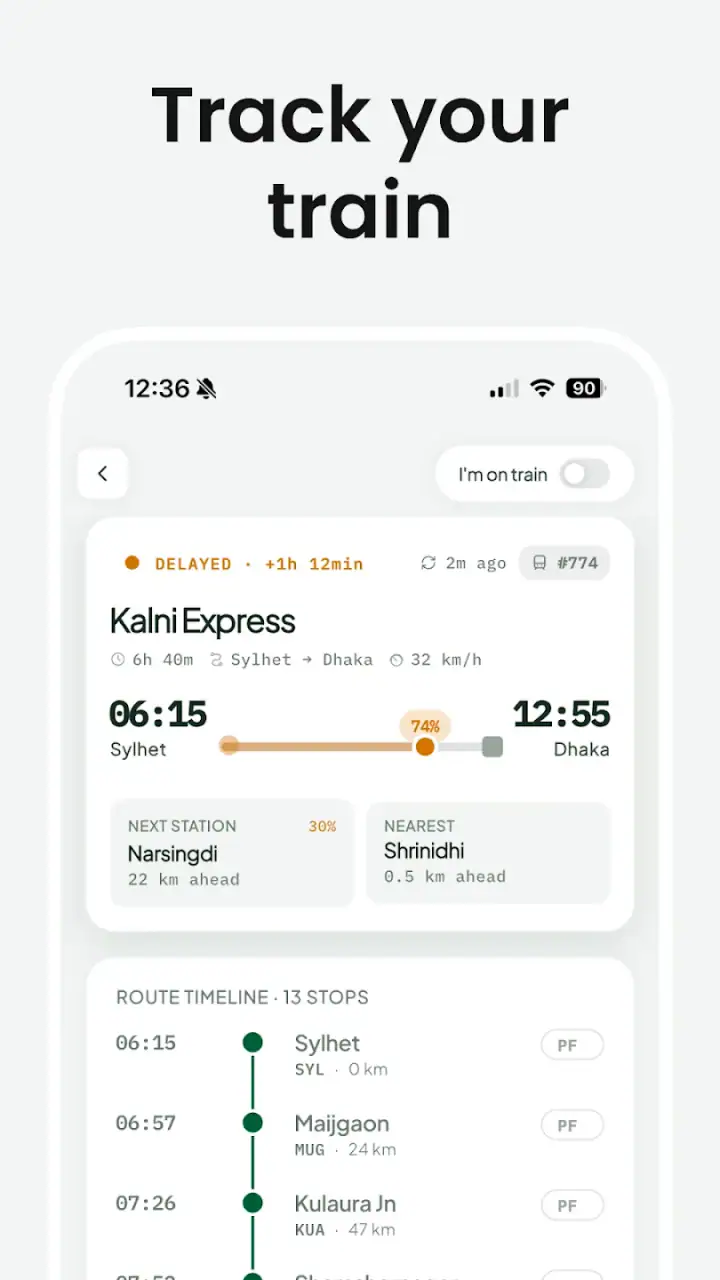
That is an important distinction. I see this as a companion to railway information, not a replacement for every source of railway information. If a station announcement gives a platform instruction or staff provide a direct update, I would follow that first. The app’s role is to give me a practical digital view of movement and delay, especially when I am away from the station.
Checking the app before relying on it
Before depending on any tracking tool for an important connection, I would perform a quick test on a normal day. I would search for a train I know, observe how clearly the result is presented, and check whether the information is easy to understand on my phone. This takes little time and reveals whether the app suits my personal way of travelling.
I would also keep the phone charged and avoid treating a single screen as the only backup. A low battery, weak mobile connection, or a temporary service issue can affect any travel app. Carrying the train number or writing down the scheduled departure remains sensible, particularly for an early morning trip or a journey involving another person.
Settings and habits worth checking
Because TrainKothai is designed around a focused task, I would not expect a long list of complicated controls. That is actually welcome. The most valuable “setting” for many users is a personal habit: decide which train matters, search for that service carefully, and avoid confusing it with another train serving a similar route or station.
On my phone, I would make sure the app is easy to reach before travel. Keeping it on the home screen or in a travel folder saves time when I am standing outside a station with luggage. I would also make sure the device allows the app to function normally under my usual battery and network settings. I am not suggesting that it requires special configuration; I simply prefer removing avoidable friction before the journey starts.
Another useful check is language and readability. Travel information needs to be understood quickly, often in bright sunlight or while walking. If a result uses unfamiliar abbreviations or presents several similar train entries, I would slow down and verify the selection rather than tapping the first option. A few seconds of careful reading is better than following the wrong service.
Experienced users can create a repeatable pre-departure checklist without pretending the app has features it does not advertise. I would open it, identify the train, note the current status, compare that status with the planned departure, and then check again shortly before leaving. This workflow is more dependable than opening the app randomly and hoping the right information appears immediately.
Where it is faster than the usual alternatives
The usual alternative is searching the web each time, checking social posts, or asking another passenger whether a train is late. Those methods can work, but they often require several steps and may mix official schedules with personal reports. A dedicated tracker gives me a more direct starting point for the one question I care about: where is my train now?
It can also be more convenient than calling someone at the station for every update. Calls are useful when I need clarification, but they are not always practical while travelling, and another person may not have a complete picture. Having a quick self-service check gives me more control over ordinary decisions, such as when to leave home or when to tell a waiting passenger that I may arrive later.
That said, the app is not automatically better than every alternative. A railway website, station staff member, or timetable may be preferable when I need route planning, fare details, ticket rules, platform information, or a complete schedule. TrainKothai’s focused design is helpful when tracking is the priority, but that same focus means I should not expect it to replace a full travel-planning service.
Faster patterns for regular passengers
Regular travellers can make the experience quicker by separating preparation from live checking. Before the travel day, I would learn the exact train name or number and confirm the departure station. On the day itself, I would use the app for movement and delays rather than spending time rediscovering basic journey details. This small separation makes the tracker feel much more efficient.
For a daily commuter, a useful pattern is to check once before leaving work and once after starting the trip to the station. The first check helps decide when to depart; the second confirms whether conditions have changed. I would not keep the screen open continuously, because that adds battery use and attention without necessarily providing better decisions.
For a person collecting a traveller, the better pattern is slightly different. I would ask for the correct train first, track that service, and agree on a meeting point that does not depend on guessing the exact arrival minute. The app can reduce uncertainty, but a clear meeting plan prevents a delay from turning into a second problem.
Families can benefit from assigning one person to monitor the train and share updates with the others. That avoids several people searching separately and reporting different services. It is a simple habit rather than a special app function, but it makes the information more useful in practice.
Another non-obvious trade-off is that a live location can tempt passengers to cut their departure time too closely. I would resist that. If the app shows a delay, I might leave later, but I would still keep enough margin for traffic, station entrances, queues, and finding the correct platform. A train’s location does not measure the time I need to reach it.
Understanding the limits of live tracking
The most important limitation is that tracking information should be read as an operational indication, not an absolute guarantee. A displayed location may help me understand the broad progress of a train, while the final arrival experience can still be affected by station procedures, congestion, or changes that are communicated locally. For that reason, I would combine the app with common sense and official announcements.
Connectivity is another practical consideration. If I am travelling through an area with an unreliable mobile signal, I cannot assume that a live update will be available exactly when I want it. I would check before entering a weak-signal area and keep the essential journey details in mind. The app is strongest when used as a current reference, not as an offline timetable stored permanently in my pocket.
I would also be careful with similar train names and repeated routes. A tracker is only useful if I select the correct service. When travelling with relatives or collecting someone, I would ask for the train identity instead of relying only on the origin and destination. That extra confirmation is one of the easiest ways to avoid following the wrong movement.
Passengers who need a complete travel-management tool may find the focused approach limiting. If my main concern is buying tickets, comparing fares, planning several connections, or finding accommodation, I would use a broader travel app or railway resource alongside this one. TrainKothai makes more sense as the tracking layer in that arrangement.
There is also a human limitation: information does not remove the need to make a decision. The app may show that a train is delayed, but I still have to decide whether to wait, change my transport to the station, inform somebody, or accept a later arrival. I appreciate tools that clarify a choice, but I would not expect this one to make the whole journey automatic.
Who should install it
I would recommend it to passengers in Bangladesh who regularly need a quick view of train movement or delay status. It is especially suitable for commuters, people meeting arriving passengers, families coordinating a journey, and travellers whose route to the station takes enough time for a delay to matter.
It is also a reasonable choice for someone who dislikes repeatedly searching through general websites. The free price removes the need to make a financial commitment, and the Everyone age rating makes it approachable for households where several people may need to check a journey. The modest install base and review count indicate that it is still a relatively focused tool rather than a universally established travel platform, so I would try it on a non-critical journey first.
I would skip it as my only travel resource if I need ticket purchases, detailed itinerary building, or authoritative help with a complicated connection. I would also avoid relying on it alone when missing the train would create a serious consequence, such as an important appointment or a tight onward departure. In those situations, I would use the tracker as one input and keep official railway information and extra time as safeguards.
My verdict after building a repeatable routine
TrainKothai succeeds because it addresses a specific travel frustration without asking me to turn the app into a full travel planner. Its most useful contribution is the quick connection between a known train, its current movement, and possible delays. When I use it with a simple routine—identify the correct service, check before leaving, verify again on the way, and keep official announcements in view—it becomes a practical everyday aid.
I especially like the way its focused purpose encourages better decisions. It can stop me from leaving far too early for a delayed train, help me coordinate a pickup, and reduce unnecessary calls. Those benefits are modest but real, and they matter most on ordinary journeys where a small amount of timely information makes the day easier.
My caution is equally straightforward: a live tracker is not the same thing as a ticketing system, timetable archive, station information desk, or guarantee of arrival. Users who understand that boundary will get more from it than users expecting one app to manage every part of rail travel.
For my own phone, I would keep this free Travel & Local app available if I travelled by train often enough to need repeated status checks. The current version, 1.1.7, gives it a clear starting point for that routine. My recommendation is to use it as a focused train-status companion, with a backup plan whenever the journey truly cannot tolerate uncertainty.
FAQs for TrainKothai - BD Train Tracker
What is TrainKothai - BD Train Tracker used for?
TrainKothai - BD Train Tracker is designed to help passengers check information about trains operating in Bangladesh. After exploring the app, its main purpose appears to be providing train schedules, route details, station information, and tracking-related updates in one place. It can be useful when planning a journey, checking departure times, or reviewing a train’s route before traveling.
Can TrainKothai track a train in real time?
The app is presented as a train-tracking tool, but users should understand that real-time tracking depends on the availability and accuracy of railway data. Some information may be based on schedules, station updates, or reported locations rather than continuous GPS tracking. Before relying on the displayed status, it is sensible to confirm important changes with the railway authority or station staff.
Does TrainKothai include Bangladesh Railway schedules and routes?
TrainKothai focuses on Bangladesh’s railway network and can help users look up train schedules, routes, stations, and related journey details. The information is particularly helpful for comparing available services between cities or checking intermediate stops. However, railway timetables can change because of maintenance, delays, holidays, or operational decisions, so passengers should verify critical travel details before leaving.
Is an internet connection required to use TrainKothai?
An internet connection may be required for loading current schedules, train statuses, route information, advertisements, or other online content. Certain previously loaded details might remain visible temporarily, but users should not assume that the app works fully offline. For the most reliable results, open TrainKothai while connected to the internet, especially when checking live updates or planning a trip shortly before departure.
Is TrainKothai - BD Train Tracker free and safe to download?
TrainKothai - BD Train Tracker may be available as a free download, although the exact features, advertisements, and optional permissions can vary by platform and version. Before installing, download it from an official app store or a trusted source, review the listed permissions, and check recent user feedback. Avoid unofficial modified versions, and remember that app information should complement—not replace—official railway announcements.
Pros
- Shows Bangladesh train schedules and routes in one place.
- Useful for checking train details before starting a journey.
- Simple layout makes basic information easy to find.
- Can help travelers compare available train options.
- Convenient reference for regular Bangladesh railway passengers.
Cons
- Information may change if railway schedules are updated.
- Coverage and accuracy can depend on available railway data.
- Some features may require an active internet connection.
- The interface may feel basic compared with larger travel apps.
- Not designed for tracking trains outside Bangladesh.


